|
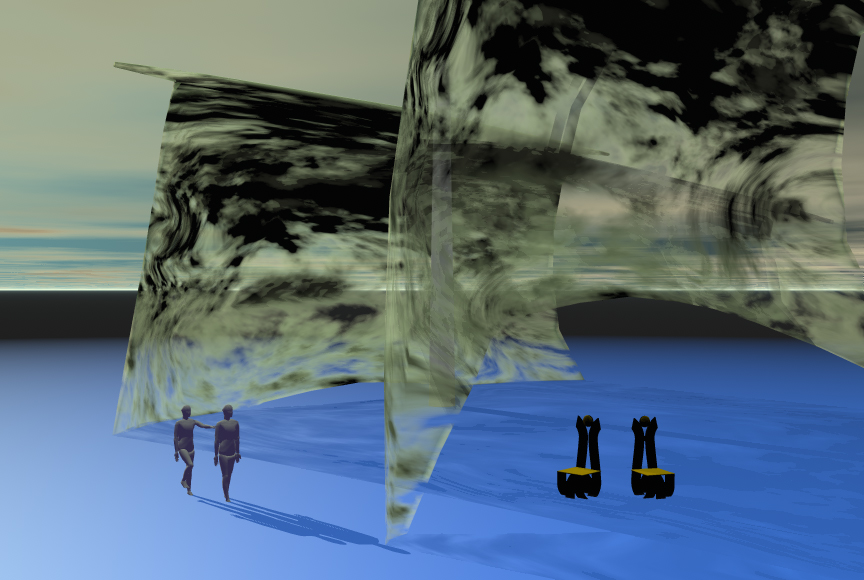
| Act I The Deck of a Ship The curtain opens during the last measures of the prelude to reveal a sea of clear and tranquil blue, and a horizon filled with far-away threatening clouds. We are in the middle of the ocean with no land in sight. During the song of the young sailor ("Westwäsrts schweift der Blick...") the two singers portraying Isolde and Brangäne enter with two chairs which they place stage left. At the same time two gigantic sails descend from the rafters and fall into place giving the suggestion that we are now on the deck of a ship. The sails are mysterious, with the imprint of a stormy sky on them: a portent for the events that will follow. This is essentially the setting for the rest of the act. There will be changes in the lighting at two key moments. When Tristan and Isolde drink the love potion the stage will begin turning dark until only two spotlights illuminate the lovers. At the end of the act, when the chorus runs onstage and the ship has arrived in Cornwall, the lighting becomes bright --blinding-- until the quick curtain. |
|
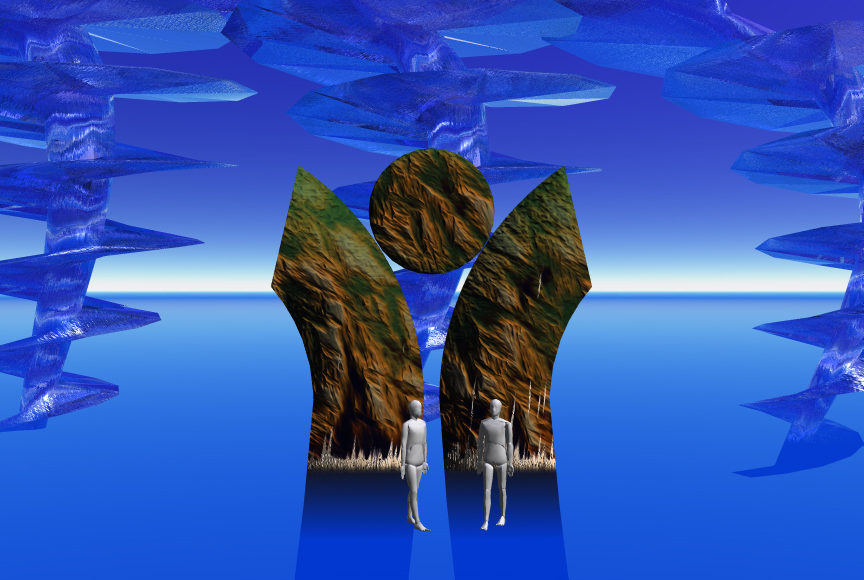
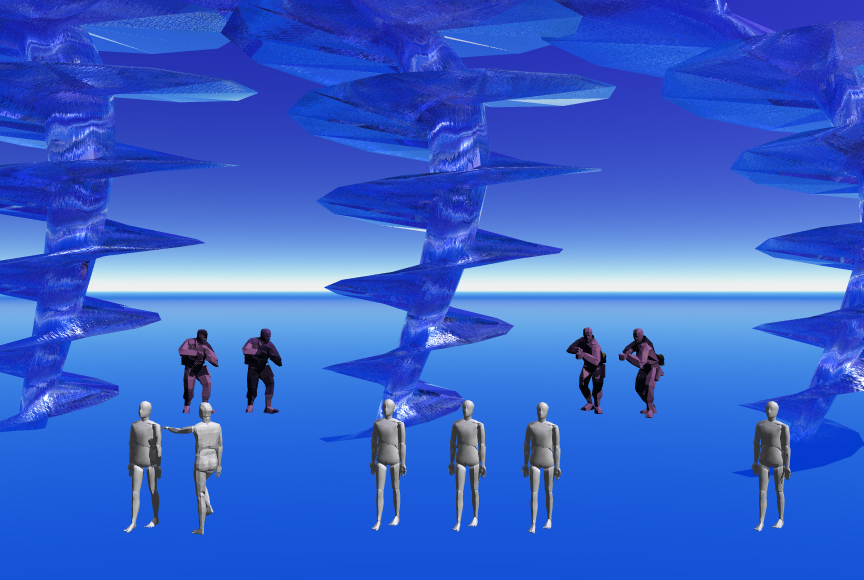
| Act II A Garden A horizon of clear deep blue welcomes us to the world of Cornwall and the home of King Mark. When the curtain opens we are immediately aware of three strange spiraling structures upstage growing from the ground. Are they trees? towers? stairs? We are also confronted by a monolithic ivy-covered sculpture that rises out of the ground center stage. Its shape should be familiar to perceptive members of the audience, for it is the same design as the backs of the two chairs in Act I. This centerpiece is the unifying visual motif of the production, and it will be a part of all the three acts of the opera. Covered by grass, ferns, and ivy, it vaguely alludes to King Mark's garden as mentioned in Wagner's stage directions. Moreover, it can symbolize the love of Tristan for Isolde, at the same time that it could remind the viewer of a tomb or an ancient funerary stella. Whatever its associations, the centerpiece should be lit in such a way so that it occupies a prominent point of reference in the act. |
|
| At the beginning of the second scene, at the moment when Tristan and Isolde begin their love duet ("Isolde, Tristan, Geliebte!") as they run into each others arms, a steel-like cage should begin growing slowly from the ground as the lights begin to dim. The key word here is "slowly," for it aims to cover the centerpiece, but it will take the entire length of Tristan and Isolde's love duet to do so. It should completely be covering the centerpiece by the time that the lovers begin singing the last part of the love duet ("O ew'ge Nacht, süsse Nacht") and it should remain in place until Brangäne interrupts the two with her piercing shriek. Symbolically, the cage grows taller as the love duet becomes more impassioned reminding us that, within the rules of the Medieval world, theirs is a forbidden love that needs to be curbed and caged before it grows out of control and threatens to tilt the society out of its equilibrium. The character of Brangäne should not be seen during the love duet, her voice, amplified, should sound its warnings from offstage. |
|
| At the moment when Tristan and Isolde sing the words "Höchste Liebelust!" and when Brangäne utters a piercing shriek, the last scene of the act begins. It is at this point that both the centerpiece and the cage that was covering it fly up to the rafters with incredibly amazing speed, leaving the stage momentarily naked with the lovers having been discovered by Melot and King Mark, who run onstage, followed by four guards, who menacingly occupy strategic spots upstage. Soon Kurvenal and Brangäne join the rest of the characters onstage. During the love duet, the lighting of the set was subdued as the title characters sang about their night of love and about death. Upon their discovery, the lighting goes back to the same level as during the first scene of the act. The stage should now feel empty, void, and dangerous, and the characters now move with an uneasy and careful step. When Melot mortally wounds Tristan, all the characters leave the stage, leaving the title character on the ground as the curtain falls. |
|
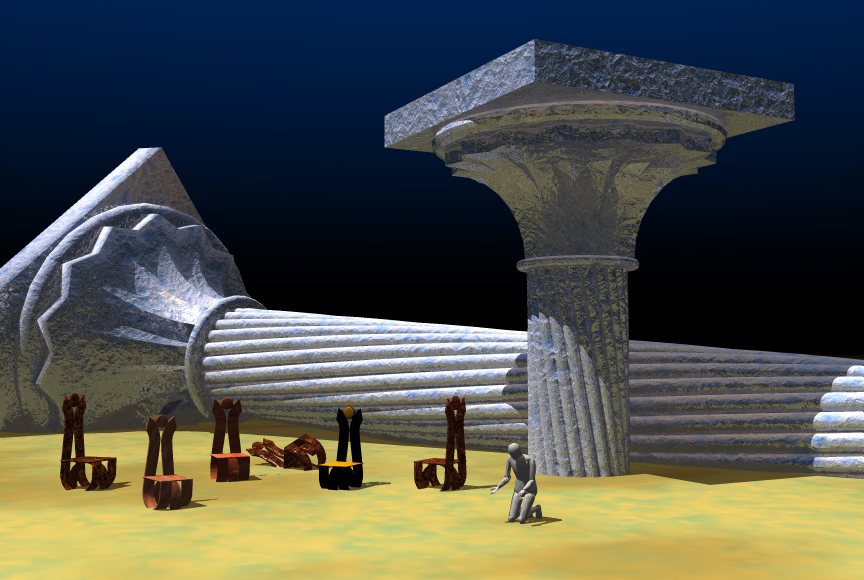
| Act III A Castle Garden in Brittany A massive Greek column is on its side, and another one stands holding up nothing. This is the ruined world of the dying Tristan. The loneliness Tristan feels without Isolde devastates him, and the ruins around him illustrate his frame of mind. Stage right, six chairs, bearing the same design as the centerpiece, are scattered about, dusty, and unused: perhaps a memory of happier times when people came to visit. Now for Tristan there is only solitude, death, and an incredible longing to be with Isolde once more for the last time. The ground suggests sand, as if what's left of Tristan's life is now totally devoted to looking out towards the ocean to see if Isolde's ship is visible on the horizon. When it is time for Isolde to sing the Liebestod, she steps towards the footlights and the curtain falls behind her. She sings the aria ("Mild und leise wie er lächelt...") lit by a single spotlight. When she finishes singing the last words of the opera ("Höchste Lust!") she exits stage right as the orchestra concludes the last remaining measures of music. |